Flight school list is your number one resource for locating the right flight schools for your flight training needs.  We have almost every flight school in the United States listed on our site.   So stop dreaming about flying and start your flight training today.  Take the first step in becoming a pilot by purchasing an introductory flight.  Do you need information about becoming a pilot?  Check out our aviation articles section for information about becoming a pilot.
Helicopter Schools

Flight School List Heading

Flight School List .Com
The Largest flight schools list in the World.
Total Global Aviation Schools: 2,562
2008
Flight Schools
Pilot Shop Direct--Aviation Pilot Supplies: Books,Flight Bags,Headsets,Software,Videos, FAA Test Guides,Aircraft Supplies,Pilot,Apparel,Pilot Training Kits and More!

Flight School Locations:

Featured Flight School

Midway Aviators Inc Midway Aviators Image

Chicago's Largest Flight School

Featured Aviation Link

Flight School Jobs Flight School Jobs Image

Aviation Jobs Post

Top Aviation Links
Our Other Pages
Aero Wiki


Flight Training Forum.Com
Multi Engine Info.Com
Flight School Jobs.Com
Flight Training Facts
What is the first step to becoming a pilot? You will have to decide what you would like to fly. FAA’s rules for getting a pilot’s license (certificate) differ depending on the type of aircraft you fly. You can choose anything from airplanes, gyroplanes, helicopters, gliders, balloons, or airships. If you are interested in flying ultralight aircraft, you don’t even need a pilot’s license.

You should also think about what type of flying you would like to do. There are several different types of pilot’s licenses, from student pilot all the way up to airline transport pilot.

Where can I get flying lessons?   You can find the top flight schools in the United States here.  All you have to do is click on your state above and find a flight school.  Give a couple flight schools a call and talk to the instructors, then decide what school you want to do your flight training at.
Is it hard to learn to fly? No. People of all shapes and sizes, ages and abilities have learned to fly. It’s fun, and from the beginning of your training, you get to do most of the actual flying! On the practical side—While flying isn’t a difficult skill to learn, you’ll have to be willing to stick with it until you meet all the requirements. Also, you should consider the cost of becoming a pilot—you’ll have to pay for your physical exam and your lessons.  Make sure you have saved up some money so you don't have to stop your flight training.  Remember the longer you wait to take your next flight lesson the more you forget.
When can I start? Right away.All you have to do is choose your state above, then find a flight school. Once you locate a flight school, give them a call.  If its not to late, and if they are not busy, you might be able to go on your introductory flight the same day.  Most flight schools offer introductory flight lessons at around $99. You don’t have to have a student pilot’s certificate or a medical certificate to take flying lessons.
What can I do with a Pilot Certificate? Go explore. You can go anywhere and rent an airplane, fly with your friends and family. There are thousands of things you can do with your private pilots certificate.

How much will it cost to get my Private Pilot Certificate? The cost really depends on you. The FAA requires a minimum of 40 hours of flight time in witch 20 to 30 hours are flight instruction and 10 hours of solo, before you can take your check ride. The national average for the private pilot students is around 65 to 70 hours of flight time.

The Cessna 172 average cost per hour is around $110 and instruction is about $40 per hour. So for the minimum amount of time required by the FAA (40 hours of witch 20 hours is Dual and 20 Hours is Solo. Total flight training cost including aircraft and instructor=$5,200. This rate does not include books or your actual FAA Test. Rates for aircraft and instructions very by location.

Is flying safe? Yes. A well-built and well-maintained aircraft flown by a competent and prudent pilot is as safe or safer than many other forms of transportation.  Flight schools aircraft are also highly maintained.
What is the difference between a recreational pilot’s certificate and a certificate? As a recreational pilot, you have to fly within 50 nautical miles of the airport where you learned to fly, you have to fly during the day, and you can’t fly in airspace where communications with air traffic control are required.  You are better off just getting your private pilots license.  It will only taky you a couple more hours.   A private pilot doesn’t have these limitations. It usually takes fewer lessons to get a recreational pilot’s certificate than a private pilot’s certificate.  Some flight schools do not offer the recreational pilots certificate.
How many lessons do I have to take before I solo? It depends on you. There is no set number of lessons or hours of flight training. Your instructor must make sure you have learned to perform certain maneuvers before allowing you to solo. These maneuvers include safe takeoffs and landings. You must use good judgment when flying and be able to keep control of the aircraft.  Also, you’ll have to get a medical certificate and a student pilot’s certificate to fly solo.
Private Pilot Eligibility Requirements

Private Pilot Eligibility Requirements

The private pilot certificate is the certificate held by the majority of active pilots. It allows command of any aircraft (subject to appropriate ratings) for any non-commercial purpose, and gives almost unlimited authority to fly under visual flight rules (VFR). Passengers may be carried and flight in furtherance of a business is permitted; however, a private pilot may not be compensated in any way for services as a pilot, although passengers can pay a pro rata share of flight expenses, such as fuel or rental costs. Private pilots may also operate charity flights, subject to certain restrictions, and may participate in similar activities, such as Angel Flight.

The requirements to obtain a private pilot certificate for "airplane, single-engine, land", or ASEL, (which is the most common certificate) are:

  • Be at least 17 years old
  • Be able to read, speak, and write the English language
  • Obtain at least a third class medical certificate from an Aviation Medical Examiner
  • Pass a computerized aeronautical knowledge test
  • Accumulate and log a specified amount of training and experience, including the following:
    • If training under Part 61, experience requirements are specified in Title 14 of the Code of Federal Regulations section 61.109 including at least 40 hours of piloting time including 20 hours of flight with an instructor and 10 hours of solo flight, and other requirements including "cross-country", 10 hours of solo (i.e., by yourself) flight time in an airplane, including at least
      • Solo requirements:
        1. 5 hours of solo cross-country time
        2. One solo cross-country flight of at least 150 NM total distance, with full-stop landings at a minimum of three points and with one segment of the flight consisting of a straight-line distance of at least 50 NM between the takeoff and landing locations
        3. Three solo takeoffs and landings to a full stop at an airport with an operating control tower.
      • Night requirements:
        1. 3 hours of night flight training
        2. One cross-country flight of over 100 nautical miles total distance
        3. 10 takeoffs and 10 landings to a full stop (with each landing involving a flight in the traffic pattern) at an airport
      • 3 hours of flight training on the control and maneuvering solely by reference to instruments
    • If training under Part 141, at least 35 hours of piloting time including 20 hours with an instructor and 5 hours of solo flight, and other requirements including cross-country and night flights
  • Pass an oral test and flight test administered by an FAA inspector, FAA-designated examiner, or authorized check instructor (Part 141 only)
The General Structure of Pilot Certification

Pilots are qualified to fly at a specific privilege level, and in one or more specific categories of aircraft. Examples of privilege level are:

  • Student: a pilot who is being trained by an instructor for their first full certificate, and is permitted to fly alone (solo) under specific, limited circumstances.
  • Sport pilot: used for Light-sport Aircraft, a category that was created in 2004. These aircraft are larger and faster than ultralights, carry more fuel, and often two occupants.
  • Recreational: a pilot who is restricted to flying short distances.
  • Private: a pilot who flies for pleasure or personal business without accepting compensation for flying except in some very limited, specific circumstances.
  • Commercial: a pilot that can fly for hire.
  • Airline Transport: a pilot that can be pilot-in-command for a scheduled airline.

Pilots are certified to fly aircraft of a specific category and class. Certain kinds of aircraft also require a type rating.

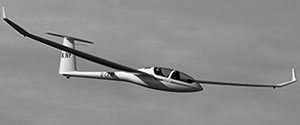
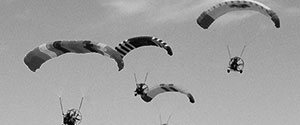
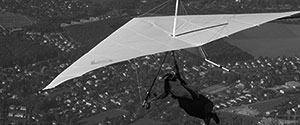
The category on a pilot certificate refers to the broad classification of aircraft that the pilot is certified to fly. Categories of aircraft include airplane, rotorcraft, glider, lighter-than-air, powered-lift, powered parachute, and weight-shift-control aircraft. Some categories are further broken down into more specific classes of aircraft.

  • Airplane class ratings include single-engine land, multi-engine land, single-engine sea, and multi-engine sea.
  • Rotorcraft class ratings include helicopter and gyroplane.
  • Lighter-than-air class ratings include airship, gas balloon, and balloon with airborne heater (hot air balloon).
  • Weight-shift-control aircraft class ratings are broken down into land and sea.
  • Powered parachute class ratings are also broken down into land and sea.

Type ratings are required in a specific make and model of airplane if the airplane is "large" (greater than 12,500 lb gross takeoff weight) or powered by one or more jet ngines. Boeing 747, DC-10, and Dash-8 are examples of type ratings.

  • ultralight category of aircraft in the US requires no specific training and no certification.

The pilot can separately add certain ratings, such as the instrumnt rating.

As an example, the captain of a 747 flying for a scheduled airline would have to have an Airline Transport Pilot certificate with an airplane category rating, a multi-engine land class rating, and a 747 type rating.

To obtain a certificate or add a rating, a pilot usually has to undergo a course of training with a certificated instructor, accumulate and log specific aeronautical experience, and pass a three-part examination: a knowledge test (a computerized multiple-choice test, typically called the "written test"), and a combined oral and practical test carried out by either an FAA inspector or a designated examiner.

Another form of authorization is an endorsement from a flight instructor that establishes that the certificate holder has received training in specific skill areas that do not warrant a full test, such as the ability to fly a tailwheel-equipped, high-performance, complex, or pressurized airplane.

Airman certificates other than student pilot certificates do not expire, although they may be suspended or revoked by the FAA. However, a pilot must maintain currency — recent flight experience that is relevant to the flight being undertaken. To remain active, every pilot has to undergo a flight revew with an instructor every 24 calendar months (unless he gains a new pilot certificate or rating in that time), and, for most types of certificate, undergo a medical examination at intervals ranging from six months to three years, depending on the pilot's age and desired flight privileges. Other currency requirements apply to the carriage of passengers or to flight under instrument flight rules (IFR).

A medical certificate is not necessary to fly a glider or balloon, or to fly with a sport pilot certificate. An ultralight aircraft can be piloted without a pilot certificate or a medical certificate.

Global Pilot Shortage!
Well this is about the best time to become a pilot. Every country in the world is desperate for commercial pilots.  The aviation industry is predicting that the airline pilot shortage could slow down the aviation industry.   The IATA predicted that flight schools will have to train about 19,000 pilots every year until 2026 to meet expected demand.  Right now the world is turning around about 16,000 pilots a year.  So you should start your flight training as soon as possible.  Find a flight school and start your flight training today.