Tailwheel and taildragger flight schools directory. So you want to fly a tail dragger , Tailwheel airplane. It only takes a couple of hours to learn to fly in a tailwheel aircraft as long as you already have your private pilots license. Here you can find tailwheel-tail dragger flight training and tailwheel-tail dragger aircraft rental locations.  Locate a tailwheel-tail dragger flight school near you.
Helicopter Schools

Flight School List Heading

You Are Viewing Our Tail Wheel Flight Schools Page
The Largest and most complete flight schools list on the Internet.
Tail Wheel Flight Schools
2008
Flight Schools
Pilot Shop Direct--Aviation Tail Wheel Pilot Supplies: Books,Flight Bags,Headsets,Software,Videos, FAA Test Guides,Aircraft Supplies,Pilot,Apparel,Pilot Training Kits and More!
   
TailWheel-Tail Dragger School Locations:
San Jose,California

Chandler, AZ

Berkeley, California

Livermore, CA

Santa Paula, CA

Morris, Illinois

Preston Aviation - A Tailwheel Flight School

Eustis, Florida

Tai Wheel Schools TailWheel Training TailWheel Lessons Tail Dragger Schools Tail Dragger Lessons
Featured Flight School

Midway Aviators Inc Midway Aviators Image

Chicago's Largest Flight School

Featured Aviation Link

Flight School Jobs Flight School Jobs Image

Aviation Jobs Post

Top Aviation Links
Our Other Pages
Aero Wiki


Flight Training Forum.Com
Multi Engine Info.Com
Flight School Jobs.Com
TailWheel-Tail Dragger Aircraft Information

Conventional(TailWheel) landing gear

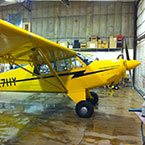
The Piper Super Cub is a popular taildragger aircraft.

The Piper Super Cub is a popular taildraggeror tailwheel airplane.
Conventional landing gear describes an undercarriage arrangement consisting of two main weight-bearing wheels forward of the aircraft's centre of gravity, the remaining weight being supported by a tailwheel or skid. The term taildragger is aviation jargon for an airplane with conventional undercarriage.

History and current use

In early airplanes, a tail skid made of metal or wood was used in place of the tailwheel. In modern aircraft, a small, articulated wheel assembly is attached to the rearmost part of the airframe.
For many years aircraft with tricycle landing gear have been more popular than those with conventional undercarriage because of ease and safety during landing. Tailwheel aircraft are, however, still preferred for specialty applications such as aerobatics, agriculture, and back-country flying; so some taildraggers are still commercially manufactured. Other tailwheel aircraft are still made in high numbers by individuals who build airplanes from plans or kits. Examples of such tailwheel aircraft are the Vans RV-4, kitfox, and the Murphy Moose.


Several after-market modification companies offer kits to convert many popular nose-wheel equipped airplanes to conventional landing gear. Aircraft for which kits are available include the Cessna 150, Cessna 172 and Piper PA-22 Tripacer.
A Cessna 150 converted to taildragger configuration by installation of an after-market modification kit.

A Cessna 150 converted to taildragger configuration by installation of an after-market modification kit.
A taildragger by Jodel: the 1965 D140C Mousquetaire

A taildragger by Jodel: the 1965 D140C Mousquetaire
Some ski-planes also have this "conventional" arrangement for their undercarriage: Two main skis and a tail ski.

 Three-point and wheeler landings

Tailwheel airplanes are landed in two distinct styles. One is referred to as a "three pointer", referring to all three wheels contacting the ground at the same time. Another type of landing taildraggers use is called a "wheeler", where the plane is flown onto the main wheels in a more level attitude, until the airspeed bleeds off and the tail stops flying.

 Tailwheel-Taildragger Characteristics

Taildraggers will behave just like tricycle gear airplane when flying. Taildraggers-tailwheel aircraft, though, have ground handling characteristics that can be challenging. In a taildragger-tailwheel airplane, the center of mass is located behind the front landing gear, which is an inherently less stable configuration than a tricycle landing gear. If the pilot is not able to keep the longitudinal axis of the aircraft aligned with the runway, then the center of mass of the aircraft will tend to rotate around the landing gear (the highest point of drag, or friction while on the ground) until the center of mass is in front of the highest point of drag. This results in an abrupt turn known as a ground loop, typically causing damage. There is no doubt that more skill is needed to take off and land a tailwheel aircraft, and some translate this to mean that tailwheel aircraft are harder to operate. However, the added skill is a benefit to any pilot, and some nosewheel pilots develop similar levels of skill without ever flying a tailwheel aircraft.


The tailwheel landing gear configuration has benefits when landing in high winds and rough, unimproved runways in that in such applications the sometimes fragile front landing gear could be easily damaged as it is often relied upon to counter any transverse loading, or side loads. A tailwheel airplane offsets side loads and maintains direction by using control surfaces, which along with the leverage from the structure of the aircraft, are made to handle such loads. In high crosswinds, as a tailwheel aircraft slows and the forces exerted by the control surfaces decrease it may be necessary to simply let the tailwheel aircraft rotate around and point nose-first into the wind. This tends to alarm untrained nosewheel pilots. The use of a locking tailwheel may reduce this weather vane tendency, but it once again adds transverse loads to parts of the aircraft structure that are not typically designed for such loads. Many nosewheel landing gear struts are structurally little more than props to hold up the front of the aircraft, and do not deal well with sideloads. It should be noted that skilled pilots of tricycle landing gear use techniques very similar to tailwheel pilots in order to avoid damaging the front landing gear in challenging situations. Also, single engine tricycle gear aircraft typically have very little clearance between the front propeller and the ground, making operations on rough or unimproved airfields problematic. This can be countered on tricycle gear aircraft by modifying the landing gear to accommodate larger tires and wheels.
Douglas DC-3, a taildragger airliner

Douglas DC-3, a taildragger airliner
While on the ground, visibility over the nose may be reduced due to the pitch attitude of the aircraft, depending on the model and geometry of specific aircraft. But, not all taildraggers have poor forward visibility on the ground. For example, the Cessna 170 taildragger has better visibility over the nose than later model tricycle gear Cessna 172s due to the increased size of the instrument panel in the later model 172s.


Taildragger versions of the same aircraft often have higher useful loads and cruise speeds due to the elimination of the nose gear and its associated drag and weight. There are experienced tailwheel pilots who insist that the added challenges of a tailwheel aircraft arise largely from a lack of skill that results from poor training when transitioning from a tricycle landing gear aircraft. Most pilots now learn to fly in tricycle gear aircraft (e.g., Cessna 152 and Cessna 172) and only later transition to taildraggers. Since the number of factory-built general aviation aircraft with a tailwheel is fairly low, the numbers of instructors experienced in this type of aircraft are also limited

From Wikipedia, the free encyclopedia Taildragger and Tailwheel Information