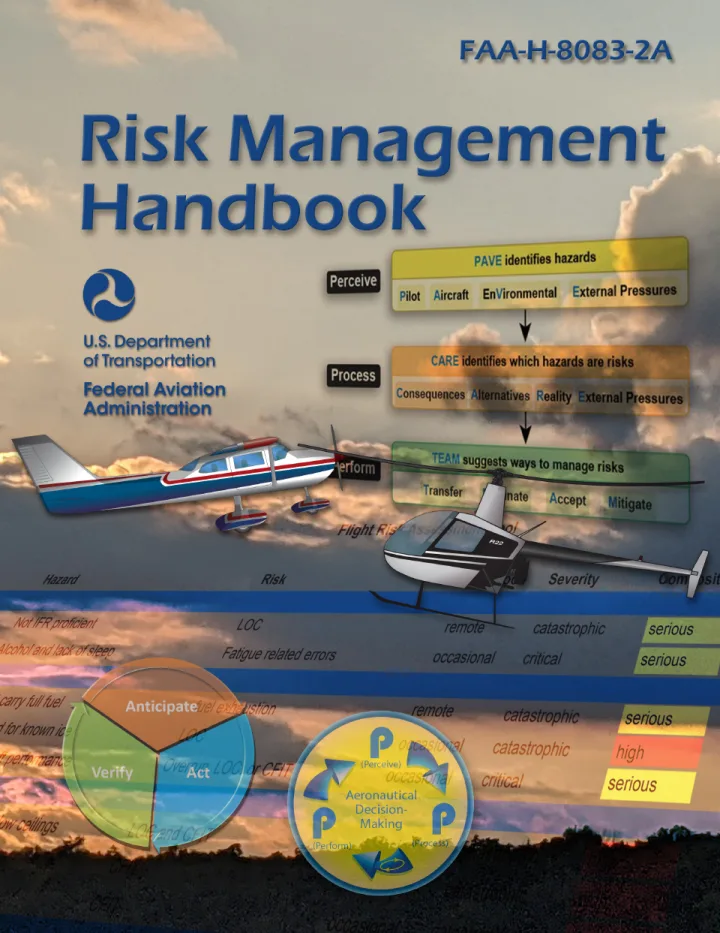
Risk Management Handbook
Aeronautical decision-making
Risk Management Handbook
Helps pilots identify and manage risk throughout flight operations.
- Publication number
- FAA-H-8083-2A
- Publisher
- Federal Aviation Administration
- Access
- Free official publication
- Best for
- Aeronautical decision-making
Purpose and audience
About this handbook
A framework for recognizing hazards, assessing risk, choosing controls, and monitoring whether those controls remain effective.
Who should use it
Student pilots, certificated pilots, instructors, and aviation organizations improving operational risk controls.
Key subjects
What you’ll learn
Hazard identification
Likelihood and severity assessment
Risk controls and decision-making
Single-pilot and crew resource management
Practical study
How to use it in training
Apply the framework to real flights and lessons. Write down hazards, controls, and trigger points so risk management becomes an observable process.
- Set an objective. Choose the chapter or topic that supports the next lesson, task, or operating decision.
- Read actively. Mark definitions, diagrams, limitations, and questions to discuss with an instructor or qualified professional.
- Apply the material. Work a scenario, calculation, briefing, simulator exercise, or supervised practical task.
- Verify current information. Check regulations, official notices, charts, and approved aircraft or equipment documents.
Edition awareness
Revision and authority notes
Risk tools support judgment; they do not make a flight safe by themselves. Use current operational information and reassess as conditions change.
Directory review date: August 1, 2026
Continue studying