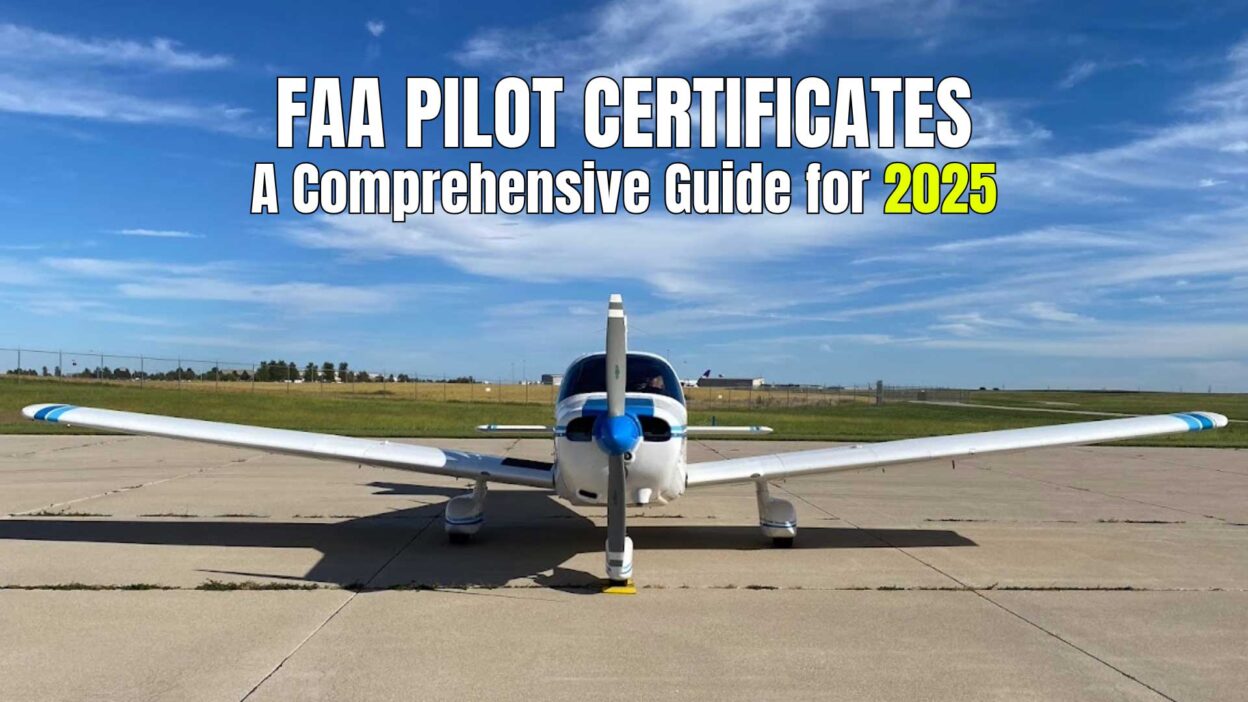
If you’re dreaming of taking to the skies, the FAA offers a range of pilot certificates to match your goals—whether you’re flying for fun, instructing others, or planning a career in commercial aviation. Each certificate comes with its own privileges, limitations, and training requirements, so it’s important to understand which one fits your path best.
Below is a detailed breakdown of all the FAA pilot certification levels, from the entry-level Student Pilot to the top-tier Airline Transport Pilot certificate, including ratings that expand your capabilities as a pilot.
FAA Pilot Certification Levels
1. Student Pilot Certificate
- Purpose: Initial step for individuals learning to fly.
- Privileges: Allows solo flight under specific conditions with instructor endorsement.
- Requirements:
- Minimum age: 16 years (14 for gliders or balloons).
- Ability to read, speak, write, and understand English.
- Obtain a third-class medical certificate.
- Validity: Does not expire.
2. Sport Pilot Certificate
- Purpose: For flying light-sport aircraft primarily for recreation.
- Privileges:
- Operate light-sport aircraft during daylight hours.
- Carry one passenger.
- Fly in uncontrolled airspace.
- Requirements:
- Minimum age: 17 years.
- Valid U.S. driver’s license (in lieu of FAA medical certificate).
- Pass FAA knowledge and practical tests.
- Limitations:
- No night flying.
- No flights above 10,000 feet MSL.
- No flights in Class A, B, C, or D airspace without additional training and endorsements.
3. Recreational Pilot Certificate
- Purpose: For flying small aircraft for personal enjoyment.
- Privileges:
- Fly single-engine aircraft up to 180 horsepower.
- Carry one passenger.
- Operate within 50 nautical miles of the departure airport.
- Requirements:
- Minimum age: 17 years.
- Obtain at least a third-class medical certificate.
- Pass FAA knowledge and practical tests.
- Limitations:
- No night flying.
- No flights in airspace requiring communication with air traffic control without additional training.
4. Private Pilot Certificate
- Purpose: Most common certificate; allows for personal and recreational flying.
- Privileges:
- Fly aircraft for personal or business purposes without compensation.
- Carry passengers.
- Fly in a wide range of airspace, including controlled airspace.
- Requirements:
- Minimum age: 17 years.
- Obtain at least a third-class medical certificate.
- Accumulate a minimum of 40 flight hours (Part 61) or 35 hours (Part 141), including solo and dual instruction.
- Pass FAA knowledge and practical tests.
5. Instrument Rating
- Purpose: Allows pilots to fly under Instrument Flight Rules (IFR), relying on instruments for navigation.
- Privileges:
- Operate in weather conditions below Visual Flight Rules (VFR) minimums.
- Fly in Class A airspace.
- Requirements:
- Hold at least a Private Pilot Certificate.
- Accumulate 50 hours of cross-country flight time as Pilot in Command.
- Log 40 hours of actual or simulated instrument time.
- Pass FAA knowledge and practical tests.
6. Commercial Pilot Certificate
- Purpose: Permits pilots to be compensated for flying.
- Privileges:
- Conduct flights for hire or compensation.
- Serve as pilot-in-command for commercial operations.
- Requirements:
- Minimum age: 18 years.
- Hold at least a Private Pilot Certificate.
- Obtain at least a second-class medical certificate.
- Accumulate 250 total flight hours (Part 61) or 190 hours (Part 141).
- Pass FAA knowledge and practical tests.
7. Multi-Engine Rating
- Purpose: Qualifies pilots to operate aircraft with more than one engine.
- Privileges:
- Operate multi-engine aircraft.
- Requirements:
- Hold at least a Private Pilot Certificate.
- Receive flight training in multi-engine aircraft.
- Pass a practical test (no additional knowledge test required).
8. Flight Instructor Certificate
- Purpose: Allows pilots to provide flight training and endorsements.
- Privileges:
- Instruct student pilots.
- Conduct flight reviews and proficiency checks.
- Requirements:
- Hold at least a Commercial Pilot Certificate.
- Pass FAA knowledge and practical tests specific to flight instruction.
- Meet specific flight experience requirements.
9. Instrument Instructor Rating (CFII)
- Purpose: Authorizes instructors to teach instrument flying.
- Privileges:
- Provide instrument flight training.
- Endorse students for the instrument rating practical test.
- Requirements:
- Hold a Flight Instructor Certificate.
- Hold an Instrument Rating.
- Pass FAA knowledge and practical tests for instrument instruction.
10. Multi-Engine Instructor Rating (MEI)
- Purpose: Allows instructors to teach in multi-engine aircraft.
- Privileges:
- Provide flight training in multi-engine aircraft.
- Endorse students for multi-engine ratings.
- Requirements:
- Hold a Flight Instructor Certificate.
- Hold a Multi-Engine Rating.
- Pass a practical test for multi-engine instruction.
11. Airline Transport Pilot (ATP) Certificate
- Purpose: Highest level of pilot certification; required for airline captains and first officers.
- Privileges:
- Serve as pilot-in-command or first officer in airline operations.
- Requirements:
- Minimum age: 23 years.
- Hold a Commercial Pilot Certificate with an Instrument Rating.
- Obtain a first-class medical certificate.
- Accumulate 1,500 total flight hours (with certain reductions applicable under specific conditions).
- Pass FAA knowledge and practical tests.
🩺 Medical Certification Classes
- First-Class Medical Certificate:
- Required for: ATP privileges.
- Validity:
- Under age 40: 12 months.
- Age 40 and over: 6 months.
- Second-Class Medical Certificate:
- Required for: Commercial Pilot privileges.
- Validity: 12 months for all ages.
- Third-Class Medical Certificate:
- Required for: Private Pilot privileges.
- Validity:
- Under age 40: 60 months.
- Age 40 and over: 24 months.
Flight Review Requirements
- Frequency: Every 24 calendar months.
- Components:
- Minimum of 1 hour of ground instruction.
- Minimum of 1 hour of flight training.
- Purpose: Ensure pilots maintain proficiency and stay updated on regulations.
👨✈️ Ready to Learn How to Fly?
If you’re ready to begin your flight training journey, check out the many flight schools available across the U.S. and the rest of the world. Click “Find a School” above to explore our directory of flight training providers. Each school profile offers key information to help you choose the right place to earn your wings.
Blue skies and safe flying!